

By Christopher Nyerges [www.SchoolofSelf-Reliance.com]
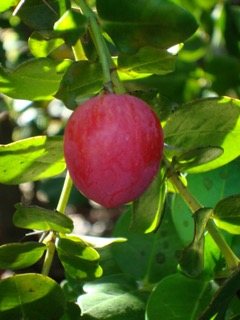
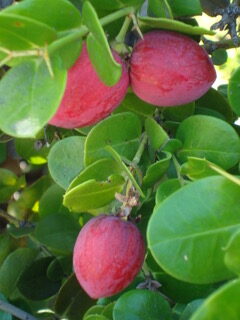
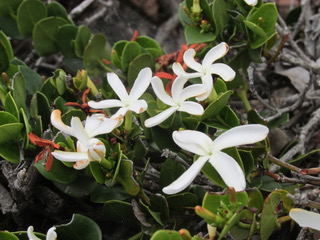
Description: Natal plum (Carissa macrocarpa) has shiny stiff green leaves and snowy white five-petaled flowers, which emit a pleasant perfume. The plant is spiny, and the fruit is an oblong berry with many small seeds. When you cut the fruit, you will see a white sap.
Uses: The fruits are eaten
Habitats: Commonly planted as an ornamental
Range: Commonly found in Los Angeles and San Diego Counties, and scattered from S. Texas to Florida.
In South Africa, the natal plum was once a staple food for Zulu and other tribal people. But after the introduction of imported commercial foods in the 1600s, the consumption of this delicious fruit declined.
Native to South Africa, where it is commonly called the Large Num-Num. In Zulu, as well as in the Bantu tribes of Uganda, it is called amatungulu. In Afrikaans the fruit is called Noem-Noem.
Natal plum is widely planted as an ornamental in private yards, around schools, and as hedges. It’s found growing throughout the West and throughout the southern states all the way to Florida. It’s an evergreen that requires very little care and upkeep, which is primarily what professional gardeners are concerned with.
The plant has rather stiff leaves and thorns and hardly seems like it could be a food. The fruits tend to be oblong, to about an inch to an inch and a half long. When you cut a fresh fruit in half, it exudes a white sap, which is alarming to most people because they have heard the old husband’s tale that anything with white sap should be avoided.
According to Specialty Produce, natal plum plants are widely planted for security because of their dense foliage and prominent thorns which makes it difficult for animals and people to walk through a hedge of this. Also, “Natal plums are used globally as an ornamental hedge, valued for their fragrant flowers that evoke the scent of Hawaiian gardenias. One of the most well-known uses of Natal plum trees in the United States can be seen in the landscape of Disneyland. The tree is found in Tomorrowland and is a part of the land’s theme of having all edible plants as decorative elements. The Natal plum tree produces edible fruits that are favored for their vibrant red coloring to enhance the overall environment of the theme park.”
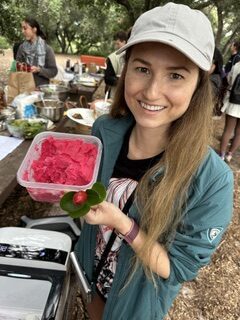
At one of the Women’s Foraging pot luck gatherings organized by Bat Vardeh in Pasadena, one of her followers brought some natal plum sherbet that she had made in her kitchen. It had a beautiful color, and the taste and texture were incredible. Try as I did to get the recipe, I never succeeded, but was told to simply follow any sherbet recipe and substitute the lilly pillies for whatever fruit they ask for.
The ripe fruit is sweet and edible and most people like it. When ripe, the fruits are a bit tangy, maybe tart. These fruits have been described as rich with Vitamin C, calcium, magnesium and phosphorus. They can be eaten as-is, or turned into pies, jellies, and jams.
According to the North Carolina State Extension, Natal plum is an easy-to-grow, spiny, evergreen, perennial shrub with dense, leathery, green leaves, fragrant, white flowers and showy, edible, red fruits. It has naturalized in Florida, Texas, and parts of Asia and is widely planted as an ornamental in Southern California. The species name, macrocarpa, means large fruit.
Natal plum will do well in full sun or light shade and organic soil in a warm, moist, tropical environment. It is easy to grow and can be sheared or hedged to fit the environment.
NUTRITION
According to the USDA, a cup of raw natal plums contains 93 calories. It contains 2 grams of fat, 0.8 g of protein, and 20 grams of carbohydrate. Also contains 60 I.U. vitamin A, 57.0 mg vitamin C, and 0.3 mg. of niacin. The mineral content is as well as 1.97 mg of iron, 16.50 mg of calcium, 390 mg of potassium, 24 mg. of magnesium, and 10.5 mg. of phosphorus.
The fruits are improved when chilled, and could be simmered or cooked in a variety of recipes that call for fruits, especially jellies.
Natal plum has an oblong berry with many small seeds. The green fruit is considered toxic, so don’t eat it.